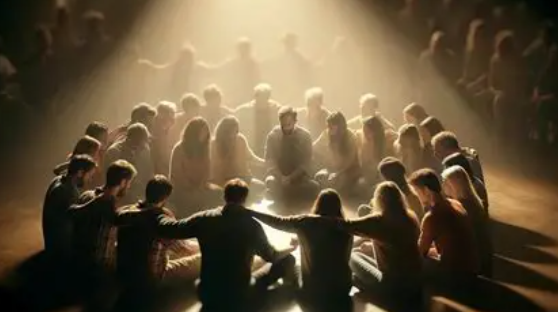
Something is happening across the African continent that is not making mainstream headlines but is quietly shaking the spiritual landscape of nations. In city after city — from Lagos to Nairobi, from Accra to Kampala, from Johannesburg to Abuja — young people are gathering in their hundreds and thousands, not for concerts or parties, but for prayer.
This is not your grandparents’ prayer meeting. This is a new expression of an ancient practice, and it is growing faster than anyone expected.
A Movement Quietly Growing
In the last five years, reports from across sub Saharan Africa have documented a significant and sustained increase in prayer gatherings, particularly among Christians between the ages of 18 and 35. These gatherings take many forms — some are organized by established churches, others are entirely grassroots, born in university dormitories, WhatsApp groups, and small apartments where young believers decided that something had to change.
The common denominator is not denomination, not music style, not format. The common denominator is desperation — a generation that has grown up watching promises go unfulfilled, that has faced unemployment, insecurity, and instability, and has decided that prayer is not a last resort but a first response.
As one young prayer leader in Lagos put it during a gathering that drew over two thousand young adults on a Tuesday night: “We tried everything else first. Now we are trying God — and we are finding that He was waiting for us all along.”
Nigeria: The Epicentre of a Prayer Revolution
Nigeria has long been known as one of the most religiously active nations on earth. Churches are not hard to find in Lagos or Abuja — they occupy every street corner, every plaza, every spare building. But observers of the Nigerian Christian landscape are noting something qualitatively different in the current moment.
The prayer gatherings that are emerging are marked by an unusual intensity and a deliberate focus on national transformation, not just personal blessing. Young Nigerians are not just praying for jobs and marriages — they are praying for their nation. They are interceding for government, for justice, for the end of corruption, for security, and for revival.
Pastor Sunday Adeleke, who leads a midsized church in Ibadan and has been in ministry for over thirty years, says he has never seen anything quite like it in his decades of service.
“In my early years of ministry,” he reflects, “when we called for a night of prayer, we would get the elderly women, the most committed members, maybe thirty percent of the congregation on a good night. Now I watch young people — bankers, students, engineers, entrepreneurs — showing up at midnight and staying until morning. Something has shifted.”
That shift, many observers believe, is being driven by a combination of factors: the pressure of a difficult socioeconomic environment that has exhausted the solutions of human wisdom; the influence of prayer focused content on social media; and what many describe simply as a sovereign move of the Holy Spirit.
Kenya: University Campuses on Fire
In Kenya, the phenomenon is particularly visible on university campuses. At several major Kenyan universities, Christian fellowships that once struggled to fill small lecture halls are now drawing crowds that overflow into corridors and courtyards.
The University of Nairobi Christian Union — one of the oldest student Christian organizations in East Africa — has reported that its weekly prayer meetings have grown from an average of forty to fifty attendees two years ago to regularly drawing over three hundred students. Their annual prayer retreat, which used to attract under one hundred participants, recently had to move to a larger venue to accommodate over eight hundred registrations.
What is driving students to prayer on campuses known for academic pressure, social activity, and the distractions of youth?
“The generation before us told us to work hard, get a degree, and you will be fine,” said one final year economics student who now leads a campus prayer group. “We worked hard. We got the degrees. And we are still struggling. We are turning to prayer not because it is easy, but because we have seen that nothing else works the way people promised us it would.”
This honest, unsentimental pragmatism about prayer — paired with a genuine spiritual hunger — is a hallmark of this emerging movement.
Ghana: Prayer Fueling Church Planting
In Ghana, the prayer movement is intersecting with another significant trend: a dramatic increase in church planting, particularly in underserved communities and informal settlements.
Leaders within the Ghana Evangelical Missions Association have noted that many of the new churches planted in the last three years were birthed not from organizational strategy or denominational initiatives, but from prayer groups. Communities of believers who began gathering to pray found that the presence of God was so tangible in their meetings that neighbors began joining, seekers began arriving, and what started as a prayer circle became a congregation.
This organic, prayerborn model of church growth stands in contrast to the more structured, programdriven approaches that have dominated evangelical church planting for decades. And it is producing results that conventional methods are struggling to match.
“The churches that are growing fastest in Ghana right now are not necessarily the ones with the best buildings or the biggest marketing budgets,” observes Dr. Kwame Asante, a Ghanaian theologian who has been studying this trend. “They are the ones where prayer is genuinely central — not as a program, but as a culture.”
Uganda and Rwanda: Prayer as Post Conflict Healing
In Uganda and Rwanda, countries that carry deep wounds from historical trauma and conflict, prayer movements are taking on an additional dimension: intercession for national healing and reconciliation.
In Rwanda, where the wounds of the 1994 genocide are still being processed by a nation that has shown remarkable resilience and progress, Christian communities have developed prayer traditions specifically focused on healing, forgiveness, and the breaking of cycles of violence and hatred. Annual national prayer days draw people from across denominational and sometimes ethnic lines in a shared acknowledgment that what their nation needs goes beyond politics and economics.
These gatherings are not naive about the complexity of their history. They do not pretend prayer erases memory or eliminates the need for justice. But they operate on the Biblical conviction that true healing — the deep, structural, generational kind — requires a spiritual dimension that human institutions alone cannot provide.
The Role of Social Media in Spreading Prayer Culture
One factor that distinguishes this current prayer movement from previous generations is the role of digital media in amplifying and connecting it. Prayer leaders who were previously unknown outside their local churches are now reaching tens of thousands through YouTube, Instagram, TikTok, and WhatsApp.
Shortform prayer content — twominute prayer videos, daily prayer point posts, scripture declarations formatted for easy sharing — is being consumed and forwarded by African Christians at a scale that would have been impossible even a decade ago. A prayer point posted to a WhatsApp group in Lagos at midnight can be in a prayer group in Accra, Nairobi, and Johannesburg by morning.
This digital dimension of the prayer movement has democratized spiritual leadership in significant ways. Young women who would never have been given a platform in traditional church structures are leading thousands in online prayer gatherings. Firstgeneration believers with no formal theological training are building substantial prayer communities online and discipling others in the practice of consistent intercession.
Challenges Facing the Movement
It would be incomplete to describe this prayer movement without acknowledging the challenges it faces.
The prosperity distortion: In some expressions of the movement, prayer has been reduced to a transactional mechanism for obtaining material blessings. The theology driving some prayer gatherings prioritizes financial breakthrough and personal success to the exclusion of prayer for others, for the nation, and for God’s kingdom purposes. Leaders within the movement are increasingly speaking out about the need for a more holistic theology of prayer.
Sustainability: Many prayer movements begin with great intensity and then fade. The challenge of sustaining consistent, disciplined prayer over years rather than seasons is one that every prayer movement in history has faced. How this generation navigates the long obedience in the same direction remains to be seen.
Leadership development: As the movement grows, the demand for mature, theologically grounded prayer leaders outpaces supply. Without solid discipleship and training, prayer movements can be susceptible to doctrinal error, spiritual manipulation, and the personality cults that have plagued previous revival movements.
Integration with local churches: Some prayer movements have developed in tension with established local churches rather than in partnership with them. The history of Christianity is full of renewal movements that began outside the church and eventually either transformed the church or became isolated from it. How this movement relates to and strengthens existing local congregations will significantly shape its longterm impact.
What This Means for the Global Church
The prayer movement rising across Africa is not occurring in isolation. It is part of a broader global pattern in which the center of gravity in world Christianity continues to shift southward. Africa is now home to more Christians than any other continent, and the spiritual vitality, theological creativity, and missionary impulse of African Christianity is increasingly shaping the global church.
Church historians are beginning to compare what is happening in Africa today to what happened in Wales in 1904, in Korea in the early twentieth century, and in China during the house church revival of the 1980s and 1990s. Each of those movements was marked by an unusual outpouring of prayer, a deep sense of God’s presence, and fruit that lasted for generations.
Whether the current African prayer movement reaches that historic scale and durability is a question that only time will answer. But the foundations being laid — the habits of prayer being formed in a generation, the hunger for God being normalized as a cultural expectation among young believers, the conviction that the transformation of nations begins on the knees of the faithful — these are foundations that matter regardless of what happens next.
Voices From the Movement
We close with the voices of those who are living inside this prayer movement every day.
Adaeze, 26, Lagos: “I started praying at midnight two years ago because I was desperate. My business had failed, my relationship had ended, and I was questioning everything I believed. Midnight prayer saved my faith and then it saved my life. Now I would not trade it for anything.”
Samuel, 23, Nairobi: “People my age are tired of church as entertainment. We want the real thing. And the real thing, we are discovering, is prayer. Not performance — prayer. There is a difference.”
Pastor Grace, 38, Accra: “My congregation is 60 percent young people. Five years ago, it was less than 20 percent. The difference? We made prayer central — not a twentyminute warmup before the sermon, but the central experience of our gathering. Young people are hungrier for God than we give them credit for.”
Bishop Emmanuel, 62, Kampala: “In my fifty years in ministry, I have seen many things come and go. Programs, methods, movements — they rise and they fall. But prayer never goes out of season. What I see in the young people today reminds me of the early days of Pentecostalism in East Africa. I believe God is up to something significant.”
A Call to Participate
If this report has stirred something in you — a longing for deeper prayer, a desire to be part of something greater than Sunday attendance — know that you do not need to wait for a movement to find you. You can start where you are.
Begin by committing to fifteen minutes of focused prayer each morning this week. Then extend it to thirty minutes. Join a prayer group in your local church. Start a prayer group if one does not exist. Pray for your nation, your city, your community — not just your own needs.
The movement begins with one person who decides to pray.
It could begin with you.
Do you attend or lead a prayer group or prayer movement in your city? We want to feature your story. Contact us through our website and share what God is doing in your community. Let your testimony encourage believers across Africa and the world.
Also read:
10 Signs Your Church Is on the Edge of Revival
How to Start a Midnight Prayer Group in Your Church
The History of the Greatest Revivals in Africa